7 Health and Wellness Web Design Best Practices

Plenty of health and wellness websites look beautiful. But good health and wellness web design needs to do much more than look pretty.
As a wellness professional, you’re on a mission to do good in the world and help others — and your website can help you do it. Seriously, your website is one of the hardest-working marketing tools you have in your arsenal. A good website should help the right people find you, quickly understand what you do, trust you, connect with your approach, explore your services, feel reassured that they can trust you, and feel confident taking the next step.
So, how do we make that happen? Let's get into it.
Health and Wellness Web Design Best Practices 👀
Plenty of health and wellness websites look beautiful. But good health and wellness web design needs to do much more than look pretty.
As a wellness professional, you’re on a mission to do good in the world and help others — and your website can help you do it. Seriously, your website is one of the hardest-working marketing tools you have in your arsenal. A good website should help the right people find you, quickly understand what you do, trust you, connect with your approach, explore your services, feel reassured that they can trust you, and feel confident taking the next step.
So, how do we make that happen? Let's get into it.
1 | include The core pages your health and wellness business needs
Not every health and wellness website needs the same five-page structure. Your page structure should reflect your services, business model, SEO strategy and what potential clients need to know. But for many service-based wellness businesses, these pages may include:
Homepage: Your high-level introduction to the business. It should quickly communicate what you do, who you help and why someone should keep exploring.
About page: Not an autobiography. A strategic opportunity to communicate your experience, values, personality, perspective and the reasons you're the right person to help your ideal clients.
Services Overview page: An overview of the different ways someone can work with you.
Individual Service Pages: Particularly useful when you have substantial offers, different audiences or different keywords you want to target through SEO.
Conditions You Treat, or Specialisations Pages: Dive deep into specific conditions or specialisations, explain your approach, and end with a CTA.
Contact or booking page: Make it easy to take the next step.
Blog: Helpful educational content can build expertise, answer potential clients' questions, and increase the number of relevant search terms your website is discovered for.
Depending on your business, you might also want pages for classes, programmes, memberships, practitioners/your team, FAQs, online courses, resources, locations or digital products. Again: Build the site around your business and your goals.
Want to know what to include on each page of your website? You’ll love my free guide — get your copy below.
2 | Conversion copy that makes people feel something, sparks connection & moves them to action
Copy and design go together like (organic) sav and summer. You can create the most beautiful Squarespace website imaginable — but if the copy it houses doesn't clearly communicate what makes your work valuable, you'll still struggle to convert visitors into clients.
This matters especially in health and wellness.
You do this work because you're driven to help people, right? Your website needs to communicate that. But it also needs to move beyond broad statements about helping people feel their best, live their healthiest life or step into their highest potential.
Strong wellness website copy should:
Speak directly to your ideal clients' needs, desires and challenges.
Clearly explain what you do.
Communicate the value and real-world benefits of your support — in language they relate to.
Show what makes your approach different, unique, and worth the investment.
Bring through your personality, personal stories, and perspective on your work or industry.
Position you as an expert, and communicate medical/therapeutic/scientific information without making your copy dry as a stale gluten-free doughnut.
Give people clear next steps!
Overcome the questions or hesitations that could stop someone from taking action, e.g., booking a call with you or purchasing a product.
And increasingly, there's another super important job: Make your business sound like an actual human is behind it.
AI can be an amazing tool for speeding up the content creation process and giving you minimum viable copy. But the health and wellness space is also becoming flooded with copy that sounds completely interchangeable.
Your perspective on your work and your industry matters. Your personality and your journey matter. Your voice and the words you use to explain your work matter. A lot! Because connection is a huge part of what helps someone choose one practitioner over another. Connection sparks when you lean into these areas. So if you use these tools, don’t lose your voice in the process. Go in and edit it. Don’t copy and paste straight from the tool.
3 | Cohesive design—not a hodgepodge
Okay. NOW we can make your wellness website pretty. :)
Cohesive design helps turn all that lovely, conversion-conscious, connection-sparking content into an experience that's easy—and enjoyable—to move through. (This is something I focused on heavily during a recent nutritionist web design intensive — see her before and after here!)
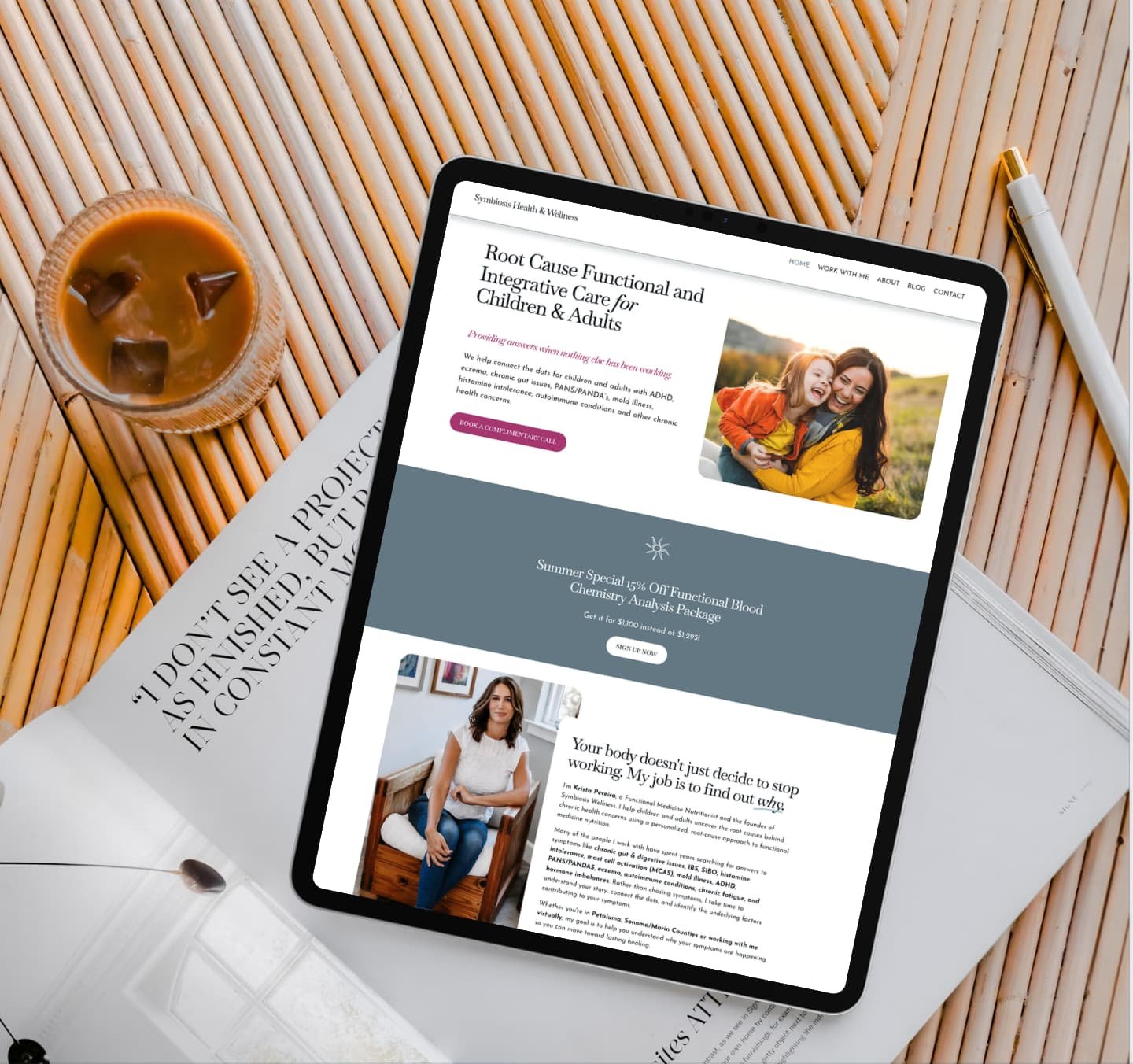
First, use white space and format your text so it’s scannable, using headings to create hierarchy down the page and chunking your copy into readable sections.
Second, your typography, colours, photography, graphic elements, buttons, spacing and layouts should feel like they belong to the same brand. When all of those elements work together, and are consistent throughout, your website will feel much more considered, cohesive, professional and trustworthy.
But it’s also worth noting that there's no one aesthetic every health and wellness website needs to follow. Your website doesn’t automatically need to be sage green and beige just because you work in wellness. *Although, I do love this palette as you can see in this therapist website design! ;)
Your website design and styling should reflect your positioning, your people and the experience you want your brand to create.
For example:
A naturopathic clinic might need to feel credible, calm and grounded. This is where those soft greens and beige might be perfect.
A women's fitness coach might prefer something bold and energetic. Think: Pink, peach, punchy, and fun.
A therapist might want warmth, spaciousness and safety. They might use more earthy clay, maroons, and warm yellows, with a lot of white space.
A premium wellness retreat might lean sophisticated and editorial — such as black, white, grey, with chic, minimalist sans serif typography.
A nutritionist with a cheeky personality might want colour, movement through a sprinkle of animations, and a bit more fun. :)
This is where thoughtful branding and web design can really capture your essence and help your business stand out to prospective clients.
And don’t forget accessibility. Clear font sizes, good colour contrast, descriptive alt text and easy-to-navigate layouts help make sure more people can actually use your website — because a site isn’t doing its job if half your visitors are squinting at it. 🙈
Don't forget your imagery!
Photography has the power to transform your brand. Investing in professional brand photography can instantly lift your website and create a polished, cohesive look. These images become versatile assets you can share across your social media, making the investment pay off many times over. Most importantly, they let potential clients connect with the real person behind the business, which is crucial in fields like clinical nutrition or therapy, where trust and personal connection matter most.
High-quality stock images can complement your personal brand photography beautifully, as long as they feel like they belong in the same visual universe. Mixing a jumble of clashing stock-photo styles with your brand photos can disrupt your brand’s harmony and make your site feel disjointed.
4 | Technology that's properly integrated
Your wellness website doesn't need to be a pretty online brochure. It can actually do things. Groundbreaking I know. But depending on your business, that could mean allowing someone to:
Book a consultation
Schedule an appointment
Join a class
Buy a programme
Make a payment
Download a free resource
Join your email list
Submit an enquiry
Access a course
Complete an intake form
Connect with your practice management software
Your website can also connect with the technology you're already using behind the scenes — such as your CRM or practice management software, email marketing platform, scheduling software, payment systems.
The goal isn't to add technology for technology's sake, but to create a smoother, easier experience for you and your clients. For example, if someone is ready to book a discovery call, we don't want them emailing you, waiting for you to respond with three available times, replying with the one that works, then waiting for another confirmation email. If we can integrate your scheduling platform and let them book directly? Beautiful.
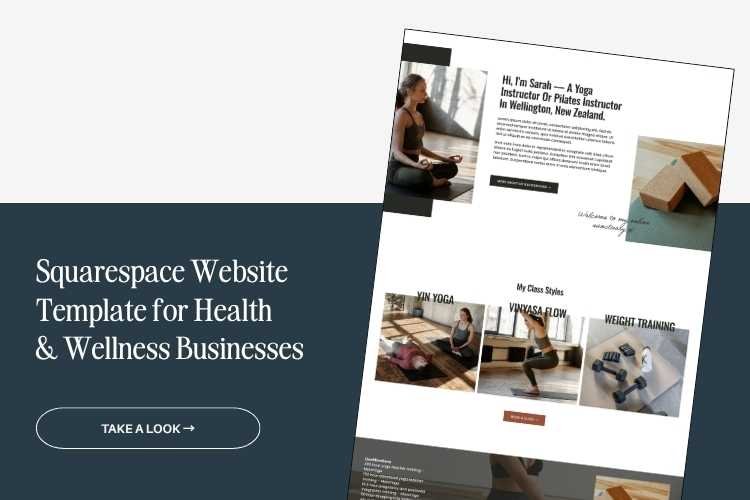
That's one of the reasons I love Squarespace for the health and wellness businesses I work with. It can become a relatively easy-to-manage central hub for your marketing, content, enquiries and offers — while integrating with the other platforms you need to run your business.
FURTHER READING ON THIS TOPIC:
Explore some of my favourite tech integrations for wellness websites »
See how I integrated Punchpass into a boutique fitness studio’s website »
5 | Search optimisation so people can actually find your site
Of course, even a strategically designed website can't do much for your business if nobody sees it.
Enter: SEO.
If organic search is part of your marketing strategy, SEO should ideally be considered while you're planning and creating your health and wellness website — rather than hurriedly adding some keywords into the mix six months later.
Good search optimisation starts with understanding what your ideal clients are actually typing into Google — and then creating a site structure and content strategy around those searches.
For example, that could include:
Nutritionist Auckland
Online health coach for weight loss
Women's health nutritionist
Functional medicine practitioner Sonoma
Reformer Pilates Totnes
Perimenopause nutritionist
Therapist for anxiety
From there, we can work out which keywords make sense for your business and strategically map them across your site, connecting different pages as we go. That might mean creating individual service pages, location pages or helpful blog articles around topics your ideal clients are already searching for.
On-page SEO can also include:
Keyword-informed headings and website copy (bonus points if you can make your copy speak to humans as well as Google — combining empathetic, engaging copy with SEO keywords is where the magic really happens. )
SEO page titles
Meta descriptions
Clear URL structures — none of this blog/adguuemdigt. Instead, choose something like /blog/wellness-best-practices
Image optimisation — compressing your images to around 250KB-500KB
Descriptive and keyword-rich alt text
Internal linking — think of your site like a Spiderweb, different pages connect to, and send people to, other ones
Useful, optimised blog content
This is another reason your website copywriting matters, and shouldn’t be an afterthought.
A three-sentence Services blurb gives Google — and your potential client — very little information about what you actually do. Whereas a thoughtful, strategic services page properly explores the service inclusions, who it's for, what problems it solves, how it works and the questions people have. That gives Google, and the humans who need your help, something to work with. And yes, it gives A.I. a lot to work with too — so A.I. tools can start recommending your services to others, which is exactly what happened to me.
6 | trust-building elements (the more the merrier)
The five elements above form a strong foundation for effective health and wellness web design. But there's one thing we can’t miss out: Trust.
Health and wellness is personal. Your potential clients aren't necessarily choosing the cheapest practitioner or the website with the fanciest scrolling animation. They will likely be sharing personal information about their health. Investing significant time or money into your support. Trying something they haven't tried before, which is scary. And searching for support after months (sometimes years) of feeling frustrated by a health issue. So they're looking for signals that say: This person understands me. They know what they're doing. Their approach feels right. I can trust them. I feel comfortable taking the next step. You need to earn their trust.
There are plenty of ways we can build trust signals into your website.
My favourites include:
Qualifications and credentials
Professional memberships
Client testimonials, where appropriate
Case studies
Media features (that “as seen in” section you see on so many websites — it carries a lot of weight!)
Your professional background
Your methodology
Your values
Transparent pricing
Helpful blog content (which you can then repurpose into social media content)
Speaking to their experience accurately, showing you “get them” and making it feel as if you’ve read their mind (this is where Voice of Customer research comes in, and sets you apart)
FAQs
High-quality photography
A clear explanation of what working together looks like
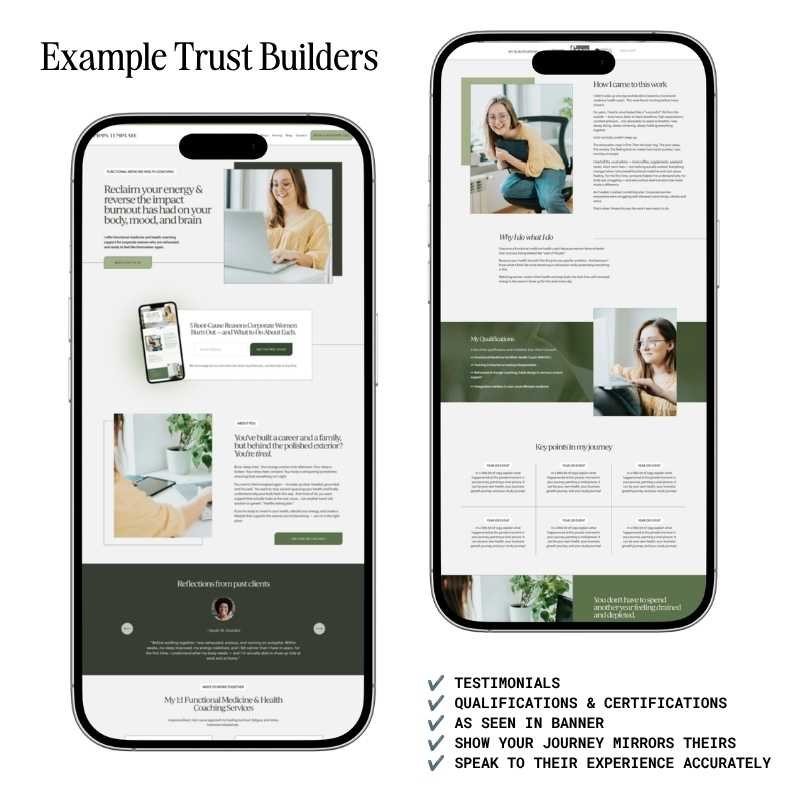
Some example trust-building elements as seen in my Health and Wellness Squarespace Website Templates - I’ve intentionally included several in each template
Oh, And please make the next step obvious!
Once someone has read your copy, connected with your approach, checked out your services, decided you're potentially their person….don't make them work out what happens next. Your calls-to-action should make that super obvious.
Depending on your wellness business model, that could be:
Book a consultation.
View the class schedule.
Explore the programme.
Enquire about working together.
Download the guide.
Join the membership.
You can also use smaller calls-to-action throughout the customer journey rather than asking someone to go from knowing absolutely nothing about you to immediately handing over their credit card. Sometimes the right next action is simply Learn more. The important part is that there is a next step then can take, if they want to.
7 | Mobile optimisation! You gotta Make sure your Health and wellness web design works on mobile too
One final thing. A website can look chef's kiss on your 27-inch desktop monitor and then become an absolute sh*t show on mobile. Always check it. Mobile optimisation isn't simply about making everything technically fit on a smaller screen.
Consider:
Is the copy easy to read?
Are your paragraphs too long?
Are buttons easy to click?
Has your photography cropped strangely?
Does the content appear in the right order?
Can people navigate easily?
Can someone quickly find your booking or contact button?
Your client doesn't care how lovely the desktop version is if they're currently Googling you from their phone. And if you’re building in Squarespace this is something to keep an eye on as when you make updates on desktop it can change things up on mobile.
Ultimately, good health and wellness web design brings all the pieces ABOVE together in a fusion of strategy, Copy, Design, SEO & tech.
The best-performing wellness websites often aren’t the trendiest or the fanciest — they’re the ones where everything feels intentional. Where the site strategy supports the business goals. The copy is clear, conversion-focused, human and heartfelt. The visual design brings the energy of the business/brand to life. The technology makes taking action easy. The SEO helps the right people find you. And all of those pieces work together to create a website that builds trust, strengthens your credibility, and help you reach your big, hairy well-meaning goals!
Want a website that Works Well for your Business?
Hello! I'm Yolie — a Squarespace website designer and copywriter specialising in health and wellness businesses.
I work with nutritionists, naturopaths, health coaches, functional practitioners, yoga teachers, and other wellness businesses in New Zealand and around the world to create hard-working, worth-the-investment websites. From custom and semi-custom Squarespace website design to copywriting, SEO strategy and focused Studio Intensives, I can help you bring all the pieces together — strategy, copy, design, SEO and tech included.