Do nutritionists need a website to start & grow A business in 2026?
Do nutritionists need a website to start & grow their business in 2026?
Let me just say — asking if you need a website to start a nutrition business, or grow a nutrition business, are two different things.
You can absolutely start a nutrition business without a website. Yes, I will say that as a website designer and copywriter!
In my experience working directly with newly qualified nutritionists (and health coaches) for over five years, many find their first clients through referrals from friends and family, networking, in-person workshops, and existing connections within the health and wellness industry.
And in fact—as you start out in your nutrition business and begin to refine your niche and positioning, and hone your skills working with clients, it can be good to just keep things minimal at first.
To promote your services with a PDF.
To have a brochure rather than a full blown site.
However, there is a difference between what gets you GOING and what gets you GROWING.
So, once you are clear on who you work with (your niche) and what your offers are (your packages and pricing), a nutritionist website is a smart investment.
Let’s dive into why nutritionists need a website at that point in their business — and what different avenues you can take to bring your nutritionist website to life. (And all of this applies to health coaches and other wellness practitioners too, FYI.)
WHY NUTRITIONISTS NEED A WEBSITE 👀
Your website actively sells your services—unlike social media.
OK, ok, let’s talk about the elephant in the room: social media. 🐘 An alternative to a site, no? NO.
Instagram is a super useful marketing platform for nutritionists. It lets you grow your audience (especially if you can master trial reels these days), share educational and inspirational content, show your personality and perspective, and build familiarity with potential clients. In fact, it can help someone feel as though they already know you before they enquire, which is amazing and important.
However, Instagram content is also fragmented. Posts disappear quickly. Highlights can feel scattered, and become messy or outdated. Captions only tell part of the story — and you are limited in how much you can share even in a carousel + caption. And chances are you’ve not covered off everything in your posts. (Because Instagram isn’t designed to go deep). Plus what works for the algorithm and grabs attention in a split second isn’t necessarily what converts clients.
That means people who follow you on social media will likely still be left with questions. Like:
What exactly do you offer in terms of packages?
What happens when I work with you?
How much support will I receive?
How much does it cost?
What happens after I enquire or book?
Those are the kinds of questions your website can answer beautifully, and clearly…in one place. And that matters! Because as the saying goes, a confused mind doesn’t buy. When potential clients understand the offer, and what you do, they feel more confident taking the next step.
Good websites are quite literally designed to communicate:
Who you help
What you specialise in
Your qualifications and experience and philsophy
The services or programmes you offer
What working together involves
Your pricing or enquiry process
The next step someone should take — AND facilitate it.
In short? They are sales tools. And if you’re thinking — can’t I just do that with a clickable PDF I link to via Instagram? Yes, you could do some of that with a sales page PDF. But you’re missing out on the other opportunities your website has to offer.
You don’t own or control your Instagram or TikTok account…and that matters.
You don’t control who sees your posts. You don’t control the algorithm. You don’t control whether your content gets shown to the people who need it. You can’t back up your Instagram. Meta is notorious for deleting accounts randomly, and limiting reach.
While social media can absolutely be a big part of how to market your nutritionist business, it shouldn’t be the only place your business lives online long-term. That is risky.
Just recently one of my friends, an amazing boudoir photography business owner, lost access to her business Instagram account unexpectedly. Her account was five and a half years old with thousands of followers. That would be scary if your whole business hinged on it, right?
Don’t put all your eggs in one basket. A.K.A. Don’t only promote your business on Instagram. Build up your search ranking (and A.I. ranking) with a website, and have a separate online home alongside your social media account.
A secondary point, but worth mentioning I think.

If you’re in Sydney and want boudoir photography, give her a follow! 🤍
Your website makes gives your business real credibility (as long as it’s done well!)
People often check your website before deciding whether to work with you.
Even if they found you on Instagram. Even if someone referred them. Even if they already like your content.
And a good website gives your business a sense of credibility through cohesive and considered design, professional photography, conversion-focused copy, a clear user journey through the site. This is especially important for wellness businesses, where trust is such a key part of the buying decision.
Put yourself in your clients’ shoes. They may be considering sharing vulnerable information about their health, their eating habits, body image, medical history … and they want to feel safe and in good hands before making contact and investing in your support.
A solid site indicates that this isn’t a hobby for you—it’s a profession.
Your website helps people find you on Google and in A.I. Search
A search-optimised nutritionist business website can create another pathway for potential clients to find you.
It gives you the opportunity to show up in search or in A.I. answers when someone is actively searching for support — such as a nutritionist in their local area, a dietician supporting a particular concern, a practitioner with a specific philosophy or specialism, or simply a nutrition programme that meets their needs as a busy parent.
They might be researching Google, Chat GPT or Claude for things like:
“nutritionist Auckland”
“nutritionist for menopause”
“intuitive eating dietician”
“dietitian for gut health”
“nutritionist for fertility”
“what foods should I avoid for acne?”
These are people who are already looking for help.
If your website clearly communicates what you do, who you help, and where you are based, and the blog is populated with valuable content, it gives you a much stronger foundation for being found by them online in Search, or get recommended by A.I. search tools. (Because A.I. sees you as an authority in this area.)
How does SEO for nutritionists work Then?
Full disclosure. SEO is not instant. Like anything in healing, it takes time. SEO is the same — you won’t see results immediately but you will see it over time, with consistency. (Another reason to get started sooner rather than later.)
And no, simply launching a website will automatically place you at the top of Google. Sorry!
Effective SEO for nutritionists requires targeted keywords put in the right places, useful content, growing your backlinks over time, and intentional optimisation in the back-end and on-page.
You need to understand what your ideal clients are searching for and create pages that genuinely answer those searches.
This is where having a clear niche or area of special interest as a nutritionist can be helpful. Someone searching for a practitioner with a specific type of experience is often more likely to connect with a specialist page than a broad description of general nutrition services. More benefits of niche-ing down!
Need help creating an SEO Strategy for your nutritionist website?
As you can see, SEO is 100% one of the reasons a website can become such a valuable long-term asset for your business. But if you’re not sure which keywords you should be targeting, I can help. Check out my SEO strategy service for wellness businesses.
Your website can heavily support your bookings, sales & enquiries.
A good website for nutritionists shouldn’t be a static brochure, it should be a functional funnel.
Depending on your setup, your website can connect with booking tools like Acuity or Calendly; payment processing via Stripe or Paypal, client portal or enquiries via Dubsado, Practice Better, and more; email marketing platforms (Kit, Flodesk, Mailchimp, Mailerlite, Squarespace campaigns); online shops where people can purchase digital products or services, and built-in enquiry forms.
So people can take action there and then, as soon as they are ready to move forwards. Making it hard for people to take the next step with you — requiring “back and forth” in your inbox — means less people are likely to. 🤍
A quick pitch for squarespace 😉
Squarespace can be a great low-cost option for nutritionists who want a professional, easy-to-manage website without needing a complex custom build. It can support beautiful design, clear service pages, SEO foundations, booking integrations, email opt-ins, landing pages, blogs, case studies, payment processing, and more.
Other options include Wordpress and Showit.
Read more: 8 reasons to choose Squarespace for your website as a health and wellness practitioner »
Your website can help you build your email list.
Your website can help you grow your email list — with opt-in boxes, announcement banners, pop-ups and standalone landing pages. You can do this by offering a relevant opt-in (could be a video training, an audio, a shopping list guide or something else) to give people a compelling reason to sign up.
Then, through email, you can educate your email community, share new offers and stories, communicate your perspective and philosophy towards nutrition, and remain visible in a way that does not hinge solely on a social-media algorithm.
Growing an email list can also help you build a more sustainable client pipeline. Instead of expecting every website visitor to enquire immediately, you can give them a lower-pressure way to stay connected until the timing is right.
Sure ManyChat can grow your email list too — it’s a both and situation not an either or. But if you’re being mindful of your business spending (who isn’t?!) a website has more benefits overall.
A website can help you establish more than one source of income
Many nutritionists begin their businesses offering one-to-one consultations and packages, and then gradually expand their work to offer other things.
You might eventually offer:
A group program
In-person or online workshops
Corporate nutrition services
Online courses
Digital resources people can purchase
Actual, IRL products!
Leading on from that, someone interested in individual support will need different information from a company looking for a workplace workshop, for example.
So a well laid-out nutrition business website gives you somewhere to organise your services and create a clear pathway for each target audience.
And your website can evolve alongside your practice. You can add new pages, resources, functionality and offers as the business grows.
In Squarespace you can start off on a basic lower-cost plan to promote a simple suite of services, and then add functionality as you go! So you’re not committed to these things in the early days of your business — but the opportunity is there for you to add income streams without having to move your site to a new platform and rebuild everything. 🤪

When should I invest in a nutritionist website, then? when is it worth my while?
A website need not be the very first investment you make when starting your nutrition practice — you’ll want to prioritise your qualifications, insurance, booking software, professional registrations or the practical costs involved in seeing clients.
You might also need to take some time to work with clients and refine your niche, your focus area, and your expertise — as I mentioned earlier.
However, as your services become clearer, you dial in your niche, and start to move past getting your first few clients, a professional nutritionist website can bring everything together and make your online presence way more impactful.
There is no single stage at which every nutritionist must invest in a website. However, there are several signs that your business may be ready.
It may be time to create or improve your website when:
You repeatedly answer the same questions in DMs
Your services are established enough to explain clearly
You feel overly reliant on Instagram or friends/family for enquiries
You want to appear in relevant Google searches
You receive enquiries from people who are not the right fit
Your existing DIY website or PDF no longer reflects your work and expertise, or the exceptional experience you provide
You offer several services and need clearer pathways
Your marketing feels disconnected across different platforms
You want a professional place to send referrals and potential clients.
Does your website need to be custom from the beginning?
Not at all! Your nutritionist website doesn’t need to be the biggest investment you make.
If you’re building your business on a budget, a well-designed website template can be a brilliant place to start.
You can begin with that as a strategic base, customise it with your own words, images, services, and brand colours / typography, and create a site that feels polished, trustworthy, and easy to use.
On the other hand, an established nutrition practice might be ready for a fully custom website with strategic copy, design and SEO support. The right option depends on your current stage, your services and how much strategic support and customisation you need.
The goal is not to spend the most money possible…it’s to choose the website solution that’s right for your current stage, while also giving you room to grow.
The most important thing, whether you use a template, semi-custom or bespoke design, is that your nutrition business website is clear, cohesive — and built around YOUR goals for your business, and the information your potential clients need to feel confident taking the next step.
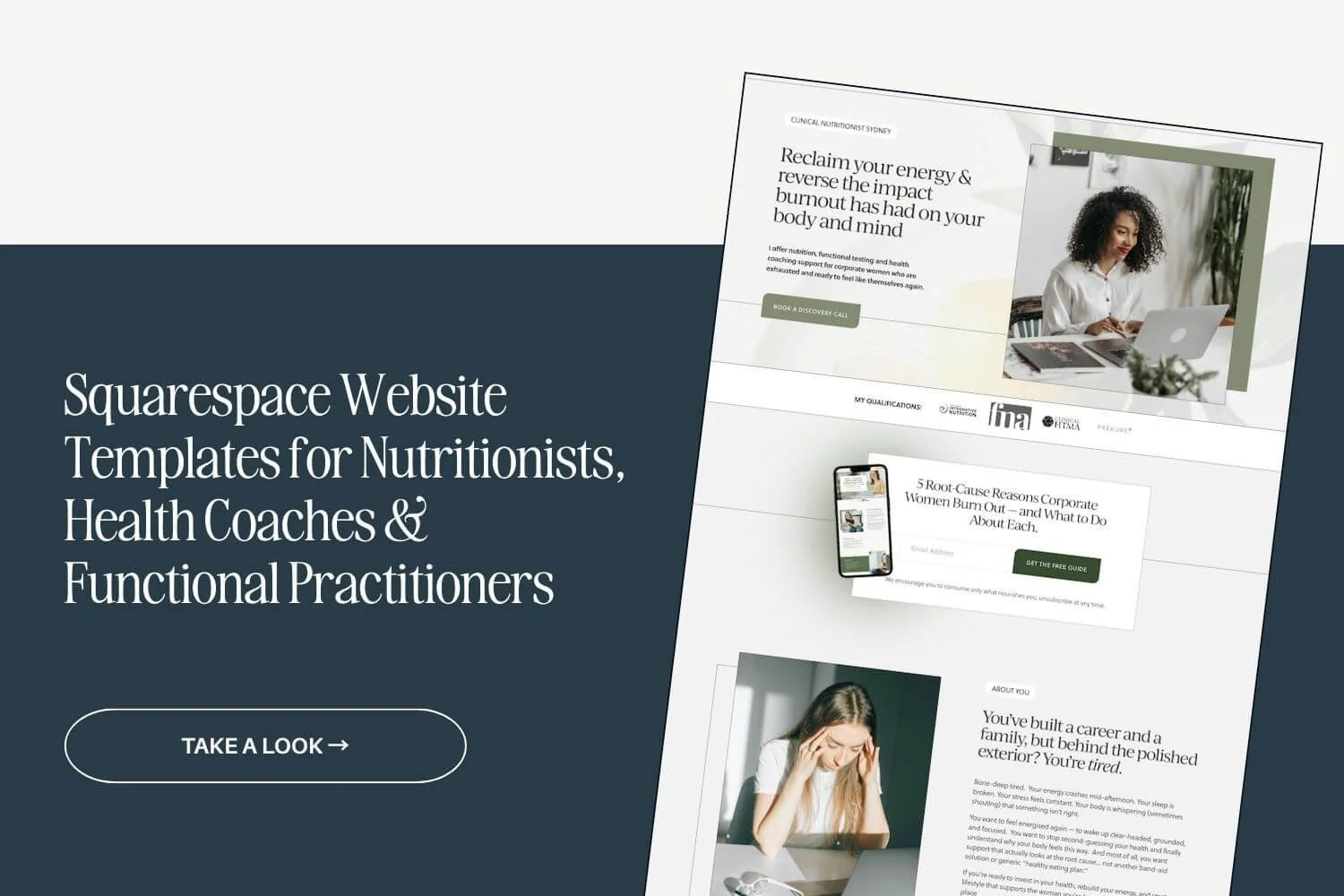
Explore the Pippa website template for nutritionists, which is designed to have all the nutritionist website essentials.
All my website templates include space for conversion copywriting and feature strategic marketing sections to help you communicate your value, share your story and perspective, and convert ideal clients.
Summary: Do nutritionists need a website to start & grow their business in 2026?
You don’t necessarily need a website before you can help your first client. Or first 5 clients! You can begin through referrals, networking, directories and social media. But as you work towards building a more established and sustainable practice, a strategic website becomes increasingly valuable.
And if you take your business seriously, a site is absolutely essential.
It can help you:
Build credibility
Clearly explain your services and specialism and actively sell your offers
Attract more suitable enquiries
Give your business a stable home beyond social media
Become discoverable through Google and A.I. search
Build an email list and a community beyond Instagram
Create a smoother booking journey with integrated tech and on-boarding/sales/marketing systems
Support new services as your business evolves
My best advice is to combine your website with other marketing strategies.
Your site (with SEO) + socials increases your visibility and gives people space to understand your philosophy, values, experience, offers, process, and personality. And it helps them feel like they know you a little before they enquire. It’s a powerful combination. Because in the wellness space, that matters—since people aren’t just buying a service. They’re choosing someone to support them. 🤍
Think about it this way.
Instagram might be where someone first finds you. Your DMs might be where a conversation starts. A podcast interview might pique someone’s interest. Your referral network might be where trust begins. But your website is the place people go when they’re ready to look closer and move forwards. It becomes the central place you direct people to. The final boss of all of your marketing.
Alrighty! I hope that answers your question “do nutritionists need a website?” :) If you want my help, keep reading.
Ready for a nutrition business website that supports your marketing — not just sits there looking pretty?
A strategic website gives your nutrition business a exactly that. Somewhere potential clients can understand what you offer, decide whether you are the right practitioner for them and take the next step there and then. Explore my Squarespace website templates for a more affordable starting point, or enquire about a custom website if you’re ready for something more bespoke.
Find your Website Template »
Explore my 1:1 Website Design Services »
Enquire here »
Frequently asked questioNS
-
Yes, a website is a valuable part of your marketing ecosystem as a nutritionist.
While Instagram can help people discover you and connect with your content, your website gives potential clients one clear place to understand your services, learn about your approach, read FAQs, explore testimonials, and take the next step. -
You can use Instagram to market your nutrition business, but it shouldn’t be the only place your business lives online.
Instagram is great for visibility and connection, but your website gives you more space to explain your offers clearly, build trust, and guide people towards booking or enquiring. -
The exact structure will depend on your practice, but most nutritionist websites benefit from including:
A homepage that clearly communicates who you help
An about page that introduces your experience and approach
Individual service or programme pages — speaking to the difference between services (and which might be the right option for them.)
Testimonials and relevant trust markers
Frequently asked questions
A contact, enquiry or booking page
An email opt-in
An optional blog or resource library
Each page should have a clear purpose. Your homepage introduces the practice. Your service pages explain the offers. Your about page builds connection and credibility. Your contact page makes the next step feel straightforward.
You need enough thoughtful website copy to help the right client understand your value, trust your expertise and make an informed decision.
Find out more about what a nutritionist website should include here » -
Yes, especially if your website is written and designed strategically.
Here’s an example of a strategic nutritionist website design, and here is another.
A good website can support your sales process, help build trust, answer common questions, and give you somewhere professional to send people after they find you through Instagram, referrals, networking, or Google. -
You don’t have to start with a fully custom website. A well-designed website template can be a great option if you want a polished, strategic online presence on a smaller budget. You can always invest in a custom website later when your business is ready for a more bespoke approach.
Check out some website templates for wellness practitioners (including nutritionists) over here! -
I was just talking to a health coach recently and they shared that their partner who runs a Personal Training business was fully-booked without a website.
And yes, that can happen. They may have been established for years, work within a strong referral network or receive clients through another platform.
But not having a website can create hands-down friction.
Clients have Qs that leave them undecided. They may want to know if you accept insurance, how much your packages are, what your professional training is — but they can’t find that information easily, so don’t move forwards.
Your practice may feel less established and credible. A clear, professional website gives prospective clients reassurance when comparing their options.
Referrals and referees may struggle to vet you. Other practitioners often want to quickly check your qualifications, services and contact details before referring you onwards, and people to whom you’ve been recommended will likely think the same!
You are harder to find. A search-optimised website helps potential clients discover you beyond Instagram and word of mouth.
You can build a nutrition business without a website. But a strategic site makes it easier for the right people to find, understand and trust you, and can minimise the leads you lose along the way — which could have presented great opportunities and people you could have helped.